
The New Security Battleground: Vulnerability Discovery and Remediation
Anish Nath - Director, Technology Research | AI & Automation
Anthropic’s Mythos story indicates a shift in the tempo of enterprise security. Project Glasswing first created the stir: Anthropic reportedly gave select organizations access to Mythos-like capabilities to help find and fix vulnerabilities in critical software.
Selective access may help critical infrastructure, but it also risks creating a two-tier security market. The best-resourced organizations get early defensive advantage, while others are told to prepare for a threat they cannot fully test against.
The latest attention around Fable shows the same broader direction: frontier models are getting better at software reasoning, while the most sensitive cyber capabilities remain tightly controlled or restricted. Public reports also suggest government agencies are already testing or using Mythos-style systems for code review and vulnerability discovery.
The hype is real, but not baseless. Independent analysis has questioned whether public evidence proves a universal cyber “super weapon”; one benchmark-style study found that even strong models missed many target bugs under controlled conditions. Another paper makes the more practical point: the near-term shift is less about fully automated zero-days and more about faster analysis, better reports, and more pressure on remediation capacity.
That is the real enterprise problem. Finding bugs is not enough. Enterprises still need to validate exploitability, trace reachability, prioritize business impact, patch safely, and avoid breaking production. Our survey of 100 enterprise leaders (conducted toward the end of Q2 2026) from global companies, focused on AI and enterprise technology strategy, including roles such as CEO, CTO, CIO, CISO, CAIO, and security operations leaders, reinforces this point. Around 81% say they are not yet well prepared to validate, prioritize, and remediate vulnerabilities at AI-generated scale. These are organizations that have controls and can handle today’s flow, but not tomorrow’s velocity.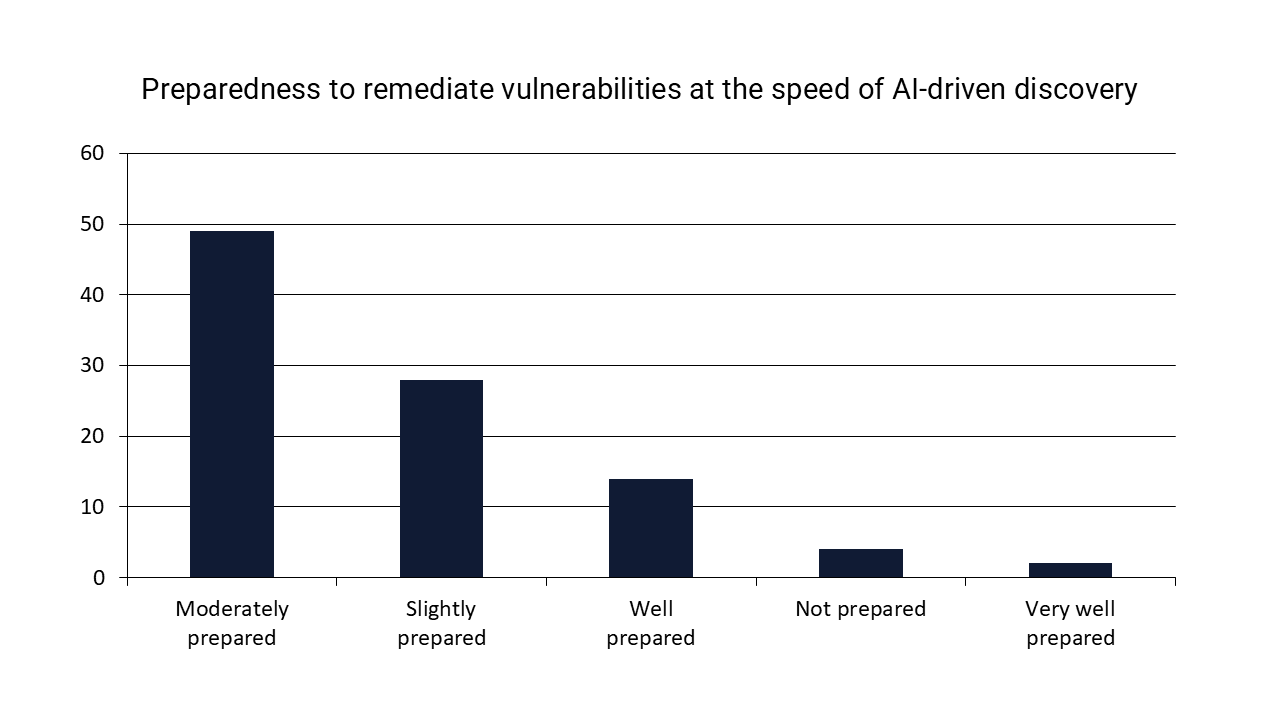
As one CISO of a large US telecom company put it: “The reality is that the bad guys are able to discover quicker than we are able to respond.”
Another respondent was even more direct: “We may have trouble patching and remediating model vulnerabilities at the pace they were found.” Chief Technology Officer, global financial services company.
As for technical implications for enterprises, we recommend to not wait for access to the “best” model. Start with the models and tools already available. Use them along with the real moat – robust harness and orchestration – to test code, review dependencies, scan exposed assets, and stress-test vulnerability workflows. Also, do not rely on familiar queues as the old severity model may break. If AI can chain low- and medium-severity weaknesses into exploitable paths, the familiar critical/high/medium/low queue becomes less reliable. One respondent said: “Patches need to be applied quickly and fully, rather than based on critical, high, medium, low type prioritization.” – Chief Information Security Officer, large financial services company in the U.S.
The sourcing implications are equally sharp. From the survey, it is clear that no enterprise appears ready to sit still. 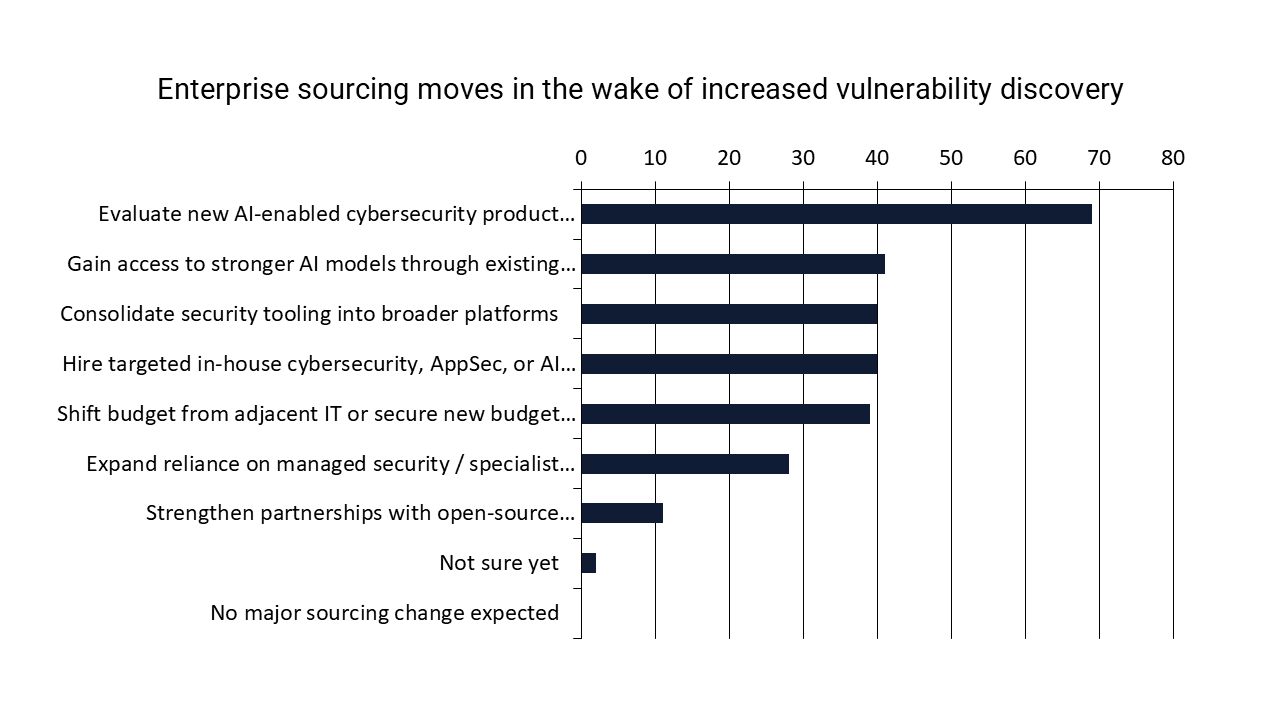
Cybersecurity product vendors get the first opening, especially those that can convert model intelligence into exposure management, prioritization, validation, and remediation workflows. Hyperscalers can win by embedding stronger models into developer and security workflows.
Additionally, there is clear preference toward proprietary models as only ~12% leaders said they are looking to strengthen partnerships with open-source communities for faster remediation.
Service providers still have a role, but as per the surveyed leaders, it sits behind product vendors at this point. The opportunity is to help clients redesign the operating model: vulnerability command centers, patch governance, application security acceleration, SecOps workflow redesign, and model-assisted remediation with human oversight.
Conclusion
The story and hype around Mythos and Fable are important not because they prove that AI will autonomously solve cybersecurity. Instead, it matters because they expose a deeper enterprise gap: vulnerability discovery is getting faster than validation, prioritization, and remediation. The real power will shift to whoever can orchestrate models, tools, workflows, people, and governance into a production-safe security operating layer.
Connect with
Our Experts
Reach out today to speak with an expert who can provide the guidance you need to navigate your challenges and unlock new opportunities. Let us help you transform data into actionable strategies!
.tmb-cfthumb_s.webp?Culture=en&sfvrsn=c9a5d760_1)

.tmb-cfthumb_s.webp?Culture=en&sfvrsn=9c794121_1)